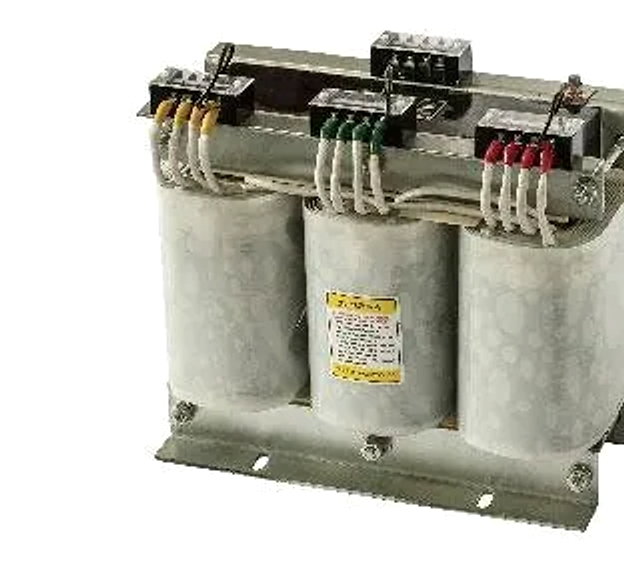
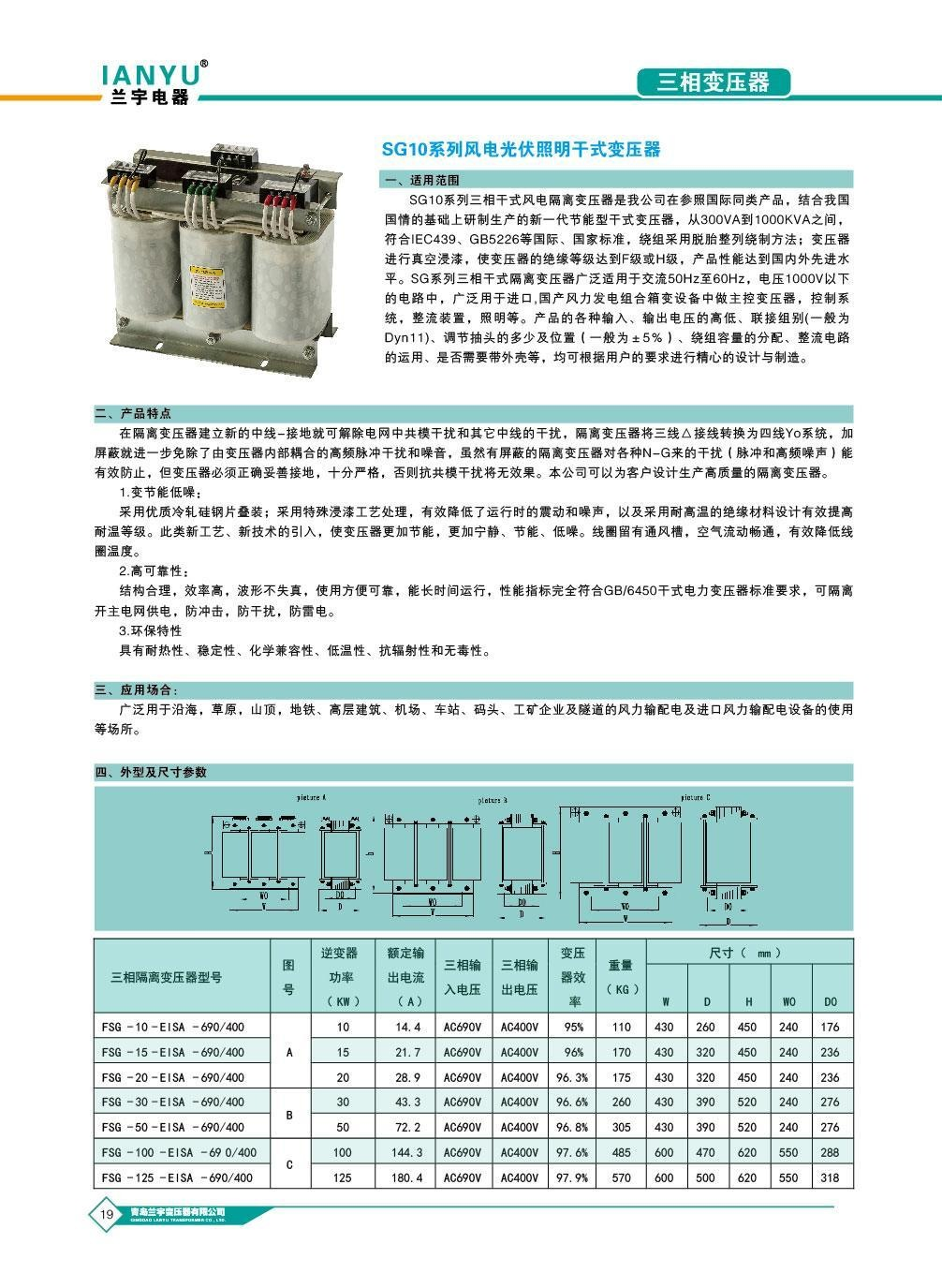
Application scope and manufacture
The brochure describes a new energy-saving dry-type design developed with reference to international products for Chinese operating conditions, covering 300VA–1000KVA. It states conformity with IEC439 and GB5226. Windings use an ordered winding process on a removable former, followed by vacuum varnish impregnation for Class F or H insulation.
For AC 50–60 Hz circuits below 1000 V, including imported and domestic wind-power packaged substations as main control transformers, control systems, rectifiers and lighting supplies. Input/output voltages, vector group (normally Dyn11), number and positions of taps (normally ±5%), winding capacity allocation, rectifier application and enclosure can be tailored.
Isolation and interference suppression
The brochure describes establishing a new neutral-to-earth connection through an isolation transformer to address common-mode and neutral interference, converting a three-wire delta supply to a four-wire Y0 system. An interwinding screen further reduces internally coupled high-frequency pulse interference and noise.
Correct earthing is emphasised: without it, the described common-mode interference suppression is ineffective. High-quality isolation designs can be supplied to customer requirements.
Features
Energy efficiency and low noise: quality cold-rolled silicon-steel laminations, a special varnish-impregnation process and high-temperature insulation reduce vibration/noise and improve temperature capability. Coil ventilation ducts allow airflow to reduce winding temperature.
Reliability: the brochure describes an efficient design without waveform distortion, convenient continuous operation, isolation from the main supply and resistance to switching impact, interference and lightning. It states performance in accordance with GB/6450, as printed.
Environmental characteristics listed are heat resistance, stability, chemical compatibility, low-temperature performance, radiation resistance and non-toxicity.
Applications
Listed environments include coastal areas, grasslands, mountain summits, metro systems, high-rise buildings, airports, stations, ports, industrial/mining enterprises and tunnels, including wind-power transmission/distribution and imported wind-power equipment.