Insulation and materials
The brochure describes voltages of several kilovolts to several tens of kilovolts between primary, secondary and core, with very low leakage-current requirements. Conventional insulation design and ordinary materials may not meet these requirements.
Epoxy resin is described as providing good electrical, mechanical and processing properties, flame resistance and adaptability to environmental conditions. The brochure gives a typical cured-resin breakdown strength of 35–50 kV/mm and volume resistivity of 10^13–10^16 Ω·cm.
Epoxy products are described as having strong adhesion, high mechanical strength, low shrinkage and dimensional stability. At room temperature or with slight heating, the material can be a flowing liquid and mixed with processing agents, facilitating casting processes in transformers, especially high-voltage/high-potential designs.
Product features
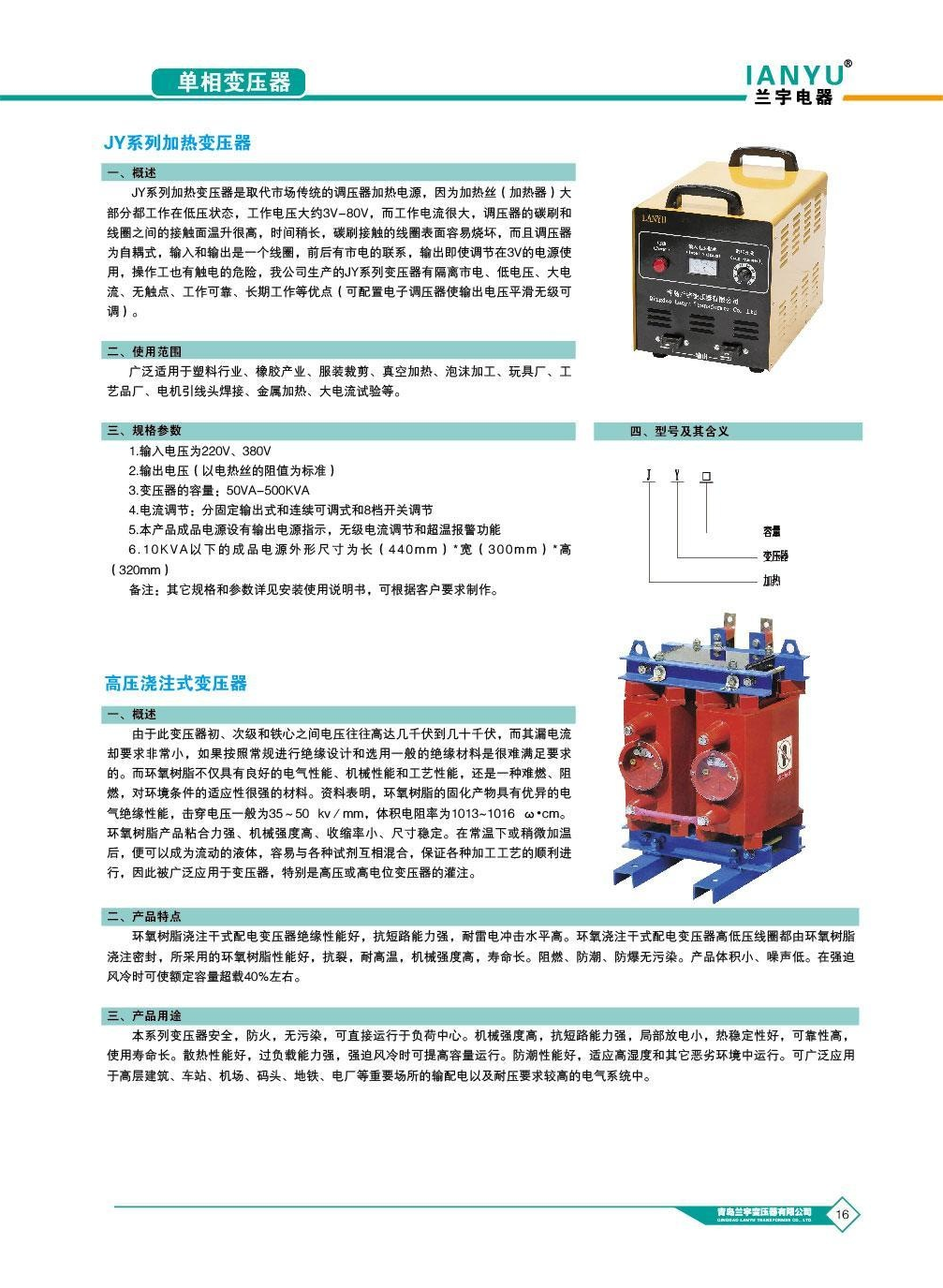
The brochure describes epoxy-cast dry-type distribution transformers as having good insulation, short-circuit strength and lightning-impulse withstand. Both HV and LV windings are cast and sealed in resin with resistance to cracking and high temperature, high mechanical strength and long service life.
It describes flame resistance, moisture resistance, explosion resistance and absence of pollution, with compact dimensions and low noise. The brochure states that forced-air cooling permits approximately 40% overload of rated capacity; operating limits must be confirmed for the actual transformer.
Applications
The brochure describes operation near load centres, fire safety, high mechanical and short-circuit strength, low partial discharge, good thermal stability, reliability and long service life. It highlights heat dissipation, overload capability and increased operating capacity with forced-air cooling.
Applications listed are high-rise buildings, railway stations, airports, ports, metro systems, power stations and other important transmission/distribution sites, as well as electrical systems requiring high dielectric withstand. It also describes operation in humid and other difficult environments.